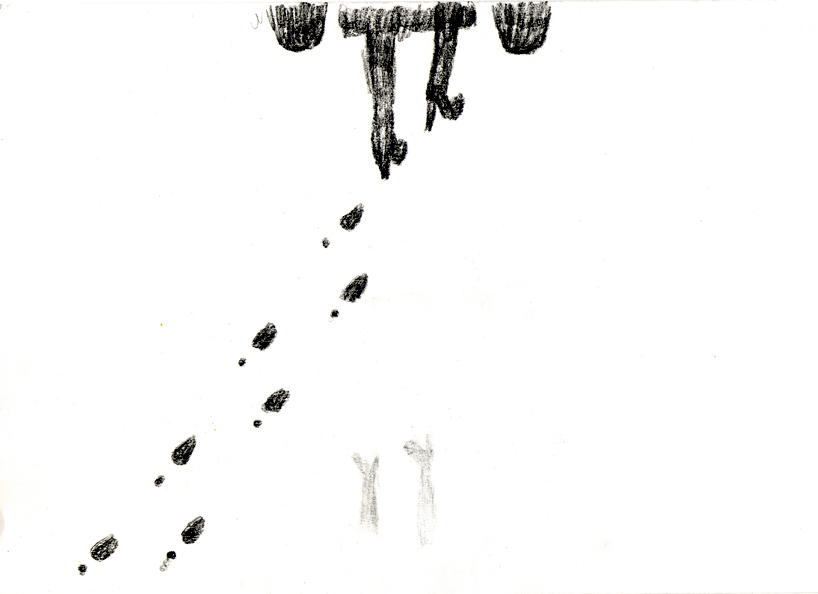
I was in fourth grade when a new teacher arrived at our school.
Her name was Dušanka, the daughter of our parish priest.
My grandmother used to do the laundry for the priest’s wife, so there
was already a certain familiarity and sympathy between us.
Whenever the teacher went to her mother’s house during the long break
or for a morning snack, she would leave me, or my friends Mira and Desa,
to watch over the class, keep order, and help the children who lived far
away finish their homework during the break.
One day she said to me:
“Would you like me to give you a pair of shoes? They are a little
uncomfortable for me. Would you like to have them?”
And I said:
“Yes, I would.”
I thought they were ordinary walking shoes and that they would be useful
for going to school.
But I was in for a surprise. They were ladies’ shoes with high heels.
Well, I took them anyway.
But I didn’t tell anyone at home. I never showed them off or even showed
them to anyone. I simply hid them in the barn.
Whenever I went somewhere, most often to fetch water, I would take off
my regular shoes and put on the high heels.
There and back.
Whoever passed by after me would see the footprints and wonder:
“How strange. Some lady has been here, walking to the spring in high heels.”
Nobody had ever gone to fetch water in high heels before, especially over
such rocky, uneven ground.
I kept doing that for days.
Sometimes I would change direction and walk downhill towards the stream
in the heels. But I would go only as far as I could. If the ground became
too slippery and I couldn’t walk in them, I would put my regular shoes
back on.
And again they would find the footprints.
Someone was walking around the village in high heels.
Then one day I put the heels on and walked straight into the house.
And I said:
“There! You thought somebody was spying on you, or that some ghost was
walking around, and all the time it was only me!”
“Well now, Nana, was that really true?”
“What do you mean?”
“Was that really true? Did you really want to play a prank,
or was there some other reason?”
“Well, no, I wanted to...”
“Did you hide those shoes in the barn?”
“I did. I hid them in the barn, yes. So that I could wear them from
time to time in order to... I was amused by their astonishment.
It never occurred to them that it might be someone from the house.
Who else could have come there? But they immediately imagined something
mysterious. And that was what amused me — that they found it mystical,
someone walking around in the middle of the night in high heels.
But now, why do you...?”
“Well, I liked it better the way you told it the first time.
Because then you didn’t say that your intention had been to play a prank.
You only said that you had hidden the shoes in the barn.
And you also mentioned footprints in the snow, while now you haven’t
said anything about snow.”
“There was mud! I never said snow! Why would I walk around in high heels
in the snow? To break my neck? No, no — it was wet, the paths were muddy,
like after rain, and footprints remained.”
“You keep changing the story every time. First of all, I don’t believe
that you originally wanted to play a prank...”
“What do you mean, play a prank?”
“I think — in fact, I’m convinced — that you hid those shoes in the barn
because it was completely unacceptable for you to wear them.”
“Oh no! That really wasn’t my intention. I would have gone around showing
them off. Wouldn’t you do the same if someone gave you something so
extraordinary? Shoes like that? Do you understand what I’m saying?
She never gave shoes to anyone. She gave them to me.
She said they were uncomfortable and asked whether I wanted them.
I would never have taken them if I had known they weren’t ordinary
walking shoes. I thought they were lace-up shoes I could wear to school
every day. I thought they were practical.
But these were shoes for dressing up. They were only for special occasions,
not something I could wear to school, or around the farm, or while tending
cattle, or around the house. Where could I wear them?
And now you question and doubt what came naturally to me in relation
to those shoes. Well, that was natural to me. And that was what amused me.”
“Aren’t you fibbing a little?”
“Excuse me?!”
“You’re telling us a story that isn’t true.”
“Well, as long as you keep taking it, I’ll keep giving it to you.”
“Well, we’re not taking it this time, and that’s why I’m pointing it out.
I don’t find your story convincing.”
“That is something completely different. And that is what you should say:
that it is not convincing enough. You cannot say that it is not true
just because I am the one telling it.
I told you before: the truth can only be told once,
and I am not going to keep proving it.”
“It is precisely because you already told the story once before that
it now turns out to have two completely different versions,
with a different tone, a different idea, a different moral.”
“Yes, and the first time I told it, you paid less attention to how
I was telling it.”
“Because the first time you told it, you didn’t give us the moral
of the story, as you did the second time.”
“Well, that is because I was under no pressure then...
You see how the mind plays tricks on us?
When there is some kind of control involved, when I know I have to tell
it again, then I feel pressure about how I am going to do it.
The first time, I simply told it as the stream of thoughts came to me.
The second time, I had to follow that stream.
Maybe that is the difference. Only that.
I tell you, try to paint the same picture twice.
Can you make it exactly the same the first and the second time?”
“All right then. Tell us the story of the storm for the second time too.
It would be good because we have the recording of you telling it the first
time, so perhaps you could tell it again.”
“About the storm?”
“Yes.”
“Well, the way I tell it now won’t be the same as the first time.”
“Do you mind?”
“No, I don’t.”
“Then try. Maybe even a shorter version.”
“I know that when people make a film, they repeat the same take.
They try to improve it, and they say: ‘All right, that’s good,’
or: ‘No, we still don’t have it — repeat it, repeat it.’
So I can repeat it a hundred times.
All right then, let’s go...”