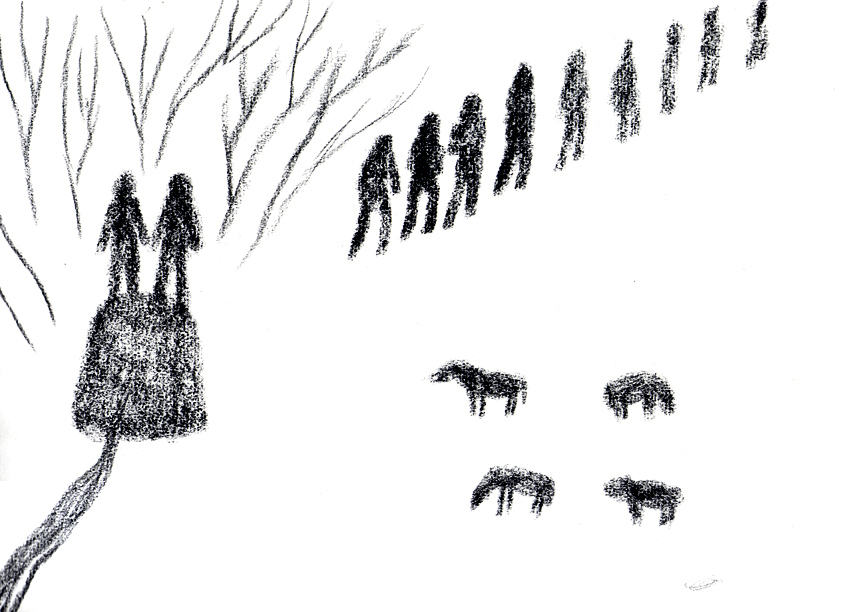
My brother and I had taken the cattle out to graze, some three or four
kilometres away from our houses. It was spring, almost Easter.
I was standing on a small hill, while Dane was a little farther down,
lower in the valley where the cattle were grazing, when I saw them —
Ustaše2 coming out,
one after another, only twenty or thirty metres away from me.
I stood there. I had nowhere to go.
They came up to me and asked:
“Whose boy are you?”
Their hands were bloody up to the elbows, and on their lapels they had
the letter “U” — for Ustaša. Each of them had a bloody axe hanging on
one side and a short, bloody sabre on the other.
As a child, right up until the end of primary school, I stuttered quite
badly. Frightened as I was, I barely managed to say:
“Đuro Gvodić’s.”
And he said:
“Where’s your father?”
We had been told:
“If anyone catches you and asks where your father or your older brother
is, say: ‘The Italians took him away!’”
So I said:
“The Italians took him away, to Kula” — the camp in Ogulin.
He shook me by the shoulders and said:
“We know Đura is with the Partisans. Are you alone?”
I glanced down towards the valley, and he knew at once that there was
someone else there.
He climbed up onto a rock and called:
“Come on, come here. You come too.”
He called my brother Dane, and Dane came over.
He said:
“Take us to the spring.”
And we walked ahead of them. Our knees were buckling. It was hard to
walk, but we had to.
We went to the spring, Jeznovac. It was a stone well, with a stone slab
on top and stones around the sides.
They wanted to make sure it wasn’t poisoned.
“Drink!”
We knelt down on the stone, but from fear you couldn’t swallow.
He grabbed my brother and me by our woollen sweaters and lifted us up
onto the slab.
“Stand there!”
Then they filled their canteens with water and stayed there for about
half an hour.
When they set off uphill towards our houses, about a kilometre from
Jeznovac, they ordered us:
“You stay right here and don’t move until you see the last one of us
up there on the hill.”
We thought that once they reached the top, they would shoot us with
a machine gun. But they didn’t.
They went on towards the houses. We couldn’t get ahead of them, we
couldn’t warn our people to flee from the ruins, so we followed behind
so they wouldn’t notice us.
They passed our house and our uncle’s. They took the Rončević,
Simić and Fajtaš families by surprise.
They killed them all. Whoever they caught, they slaughtered.
Then they threw them, some still alive, into the stone water cisterns
and piled stones on top of them.
They continued on towards the Mrežnica. There, on the Mrežnica,
my aunt — my father’s sister — and her husband had a watermill
and eight children.
My uncle crossed the Mrežnica by boat. The river there was fifteen
or twenty metres wide. He couldn’t call out to them over the roar
of the waterfall.
They took them out of the mill and slaughtered all twelve of them.
Then they went up the hill towards Tobalić and the other villages,
and my uncle came upon the scene of the massacre.
He saw a three-year-old child moving one little leg from beneath
his mother’s skirt.
He picked him up in his arms, helpless, trying to help him.
Then he came across a Partisan patrol. They took the child from him
and brought him to a field hospital.
They treated his wounds there, and the little boy survived.
He later became a doctor.
He was the only one who survived.
* * *
I stayed at the hospital until 6 December 1944, when liberation came,
and I was determined to go to the front at any cost.
I thought:
“My place really wasn’t in Dedinje.”
I had been through such a life. I came from those parts where people
had suffered so terribly, and I didn’t have an idea, as others did,
that I belonged to some party or some organisation.
What I had was simply that emotional bond with my family, and with
all the people who had suffered.
That was why I wanted to go.
* * *
1
The only story in the book that is not Nana’s, but comes from her younger
brother Rade, who was six years old at the time of the events described.
↩
2
The Ustaše were members of the Croatian fascist movement that ruled the
Independent State of Croatia (NDH), an Axis puppet state established in
1941, and carried out systematic persecution and mass killings of Serbs,
Jews, Roma, and political opponents.
↩