It’s been three years now since the first time we went with Nana to Primišlje.
This is how it all took place. Sometime around her eightieth birthday, my Nana
turns around and tells me: “I’ve been through so much, and for the most part
I can say that I am content with how things came to pass… I now have only one
unfulfilled desire, and that is to go with you to Primišlje… Well now, if we
could somehow arrange for that to happen, all would be fine in my world...”
Primišlje is my Nana’s place of birth, and the last time she visited it was
almost five decades ago. It is situated in the Kordun region, in what is now
the neighboring state of Croatia. Long ago, back in 1940, as World War II was
breaking out, at the age of only fourteen, Nana left home to “learn a trade”
in Belgrade, as was customary at the time.
The two other opportunities she had to set foot in this area again presented
themselves only after World War II: the first time she headed back home
straight from the front line, eager to surprise her family; and the next and
last time, she went to visit with her husband and their two children. Soon
after, her parents and six brothers and sisters left Primišlje for good,
settling permanently in and around Belgrade. No member of the family remained
in Primišlje. In the meantime, another war stormed through this area, and the
miles of distance grew even greater.
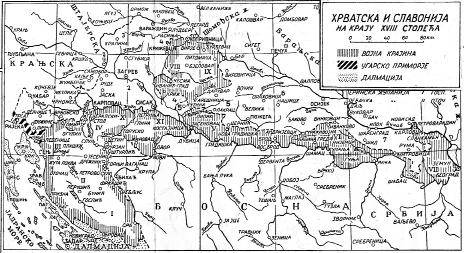
Military Frontier / Vojna Krajina
Primišlje is a village in the municipality of Slunj, in the region known
as Kordun, historically part of the Vojna Krajina (Military Frontier).
I too had my reasons for this journey. When I was a very little girl,
my Nana used to tell me stories from her childhood, and I would vividly
picture the meadows where she took her flock to graze, the springs with
cold pristine water, one at the foot of the hill, the other on the hilltop,
and the swift clear rivers, the Mrežnica and the Korana, cutting through
the landscape, with frolicking rapids and foaming whitewater…
The possibility, now opened up by Nana’s invitation, that this place was
real and actually existed beyond the realm of my imagination — and that
it could actually be visited — was a true revelation for me.
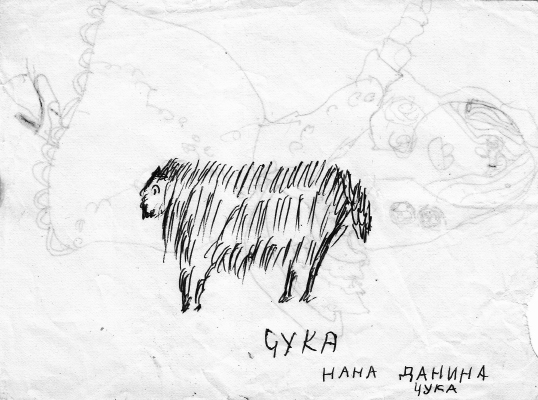
Čuka — drawing by Nana
Several months after Nana had expressed her wish, everything was ready
for us to go. We climbed into a van — my mother, Nana, my friend Dionis
with his camera, and myself — ready to set out on an adventure into the
past and memory, a quest for the subtle ties between landscape and the
stories spun from a lifetime of experience, intertwining to shape a
human existence.
Leaving Karlovac, the last big town, behind us, we put away our maps
and Nana became our guide. We were entering a different territory, one
through which we could travel not only in space but also in time, reading
through layers of the past and projections of the future, a place where
everything around us had been the backdrop of events long gone, and of
those yet to come.
The very entrance to this land was marked by the “Future Museum of the
Homeland War” — at least that was what the banner read, suspended over
a demolished, bullet-riddled building standing in the middle of a field,
surrounded by rusting tanks and other military vehicles and aircraft,
all now caught in spiderwebs.
Balconies of houses lined up along the road carried signs reading
“ROOMS, ZIMMER, SOBE”, protruding from arrangements of red and white
begonias. As we approached Primišlje, the situation changed and nature
gradually overtook the human presence.
After a while, we began to distinguish clearly between two kinds of
ruins: those made of stone, dating from the Second World War, and those
made of brick and concrete, left by the most recent war in the 1990s.
Both were now overgrown with lush vegetation, with trees growing out
through their gaping openings.
The few inhabited houses all looked alike, built of bare brick and
without façades. People later explained to us that these houses had
been built with state funds allocated to returnees — refugees from the
war of the 1990s whose homes had been burned and destroyed.
Whenever we saw a “living soul” along the road, we had to stop, and
Nana would jump out of the van to say hello. At first people would look
at us suspiciously, but as soon as Nana briefly explained her family
lineage, they would thaw. Before long, some connection would emerge —
through family, relatives, godparents, or someone from our family who
had gone to school with someone from theirs.
This usually resulted in an invitation for rakia — Dionis’s favourite
part — and offers of food and drink.
Most of the people we encountered there were well past the prime of
their lives: returnees who, after years spent as refugees following the
war of 1995, had decided to return and be “their own masters”, having
failed to find better living conditions elsewhere.
They now lived here on modest pensions, starting again almost from
scratch after their households had been destroyed. They ate food they
grew themselves and tried to protect their gardens from the constant
raids of wild boars, deer and rabbits. Even experienced hunters, in
this densely forested region full of game, now found it difficult to
obtain hunting licences.
Since the village had lost its grocery shop long ago, all other
provisions arrived in weekly deliveries.
Three bullet-riddled buildings marked the centre of the village:
the former community centre, the infirmary and the post office.
Broken windowpanes, where any remained, and walls open to the rain
now provided fertile ground for moss, ferns and other vegetation.
The floors were scattered with filing folders, birth certificates
dating throughout the twentieth century and receipt forms, all giving
the impression that at some point activity in this part of the world
had come to an abrupt halt.
Along the way, we repeatedly stopped to look more closely at monuments
erected in memory of the victims of the People’s Liberation Struggle.
Where once hundreds of names of the dead had been engraved in gilded
letters on massive black granite plaques, there were now only gaping
holes.
“Gone with the Storm,” a passer-by remarked as he stopped, curious to
know the reason for our visit.
From time to time, a sign by the roadside warned us of a minefield.
Whether the warnings were outdated or not, we never dared to find out.
Bullet casings and even soldiers’ helmets collecting rainwater in the
grass reminded us that the fighting had not taken place so very long ago.
We also noticed that whenever the war came up in our conversations with
local people, silence often followed. They seemed to have little desire
either to listen or to comment. They spoke about it only when asked, and
even then chose their words carefully, often leaving sentences unfinished.
We could all see how deeply this affected Nana. She tried to impose
another, more cheerful version, telling us in great detail how she
remembered everything: full of life and spirit, beautiful, with people
and animals everywhere — so different from what now appeared before us,
a deserted and socially devastated landscape.
Along the way we picked pears, apples, plums and walnuts ripening in
dense, overgrown treetops that now yielded less fruit. We were dazzled
by the most precious thing this landscape had to offer: the Mrežnica
River, with its rapids and waterfalls.
Dionis and I, seeing it for the first time, could hardly comprehend
what terrible thing must have happened to the people here for them to
have decided to leave such abundance behind and never look back.
To our surprise, Nana mentioned certain plots of land scattered across
these hills that were, in a sense, “ours”. However, as is often the case
in large families, this was not a subject that could be discussed lightly.
About a week later, our journey came to an end, and we had approximately
twenty hours of video material. We parted ways, arranging to meet Dionis
somewhere in a month or two to view the footage and begin editing the film.
Several months later I was in Barcelona, just finishing something at my
computer, when my cell phone rang. It was Dionis, calling from Berlin.
I was happy to hear his voice because it had been a while since I had
heard from him. In fact, all trace of him had disappeared several weeks
earlier, when he got into his van, packed all his belongings and left
Barcelona to settle in Berlin.
He quickly interrupted my expressions of delight, continuing in a
dejected, miserable tone of voice:
“Something happened...”
After a short pause, he continued:
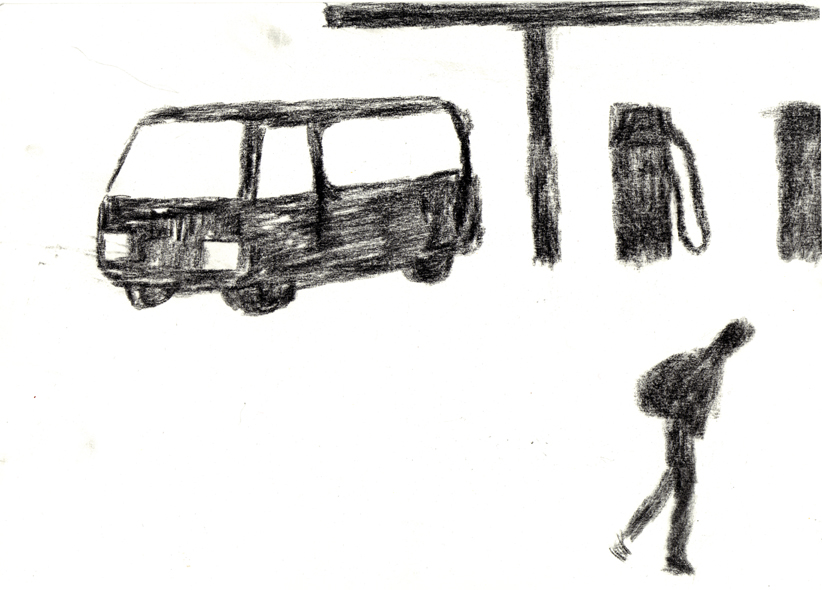
“On my way to Berlin, someone broke into my van when I stopped at a gas
station. My camera was stolen...”
Oh, all right, I found myself thinking. It was really ancient, and he had
said that he intended to get a new one. But that still wasn’t it. After
another pause he continued:
“In the bag with my camera I also had all the tapes from Primišlje, and
two Dead Man tapes.3”
The latter part of the sentence slowly seeped into my ears, but my brain
had difficulty absorbing the sounds and linking them into a meaningful
piece of information. A sudden vacuum in my lungs made me burst out of
the building, with the cell phone glued to my cheek.
“I feel horrible too,” he went on, since I could hardly bring myself to
utter a word. “And it’s been ten days now that I haven’t been able to
sleep. I didn’t call you because all this time I kept hoping that maybe
they would somehow turn up somewhere...
“I stopped somewhere along the way, just as I was about to leave France,
for a coffee break at a gas station. I parked the van right outside the
café window so that I could keep my eyes on it at all times. I never took
my eyes off it; all my equipment was there.
“I drank my coffee and left the café to continue my journey. I was already
a good eighty kilometres into Germany when I noticed that the back door
wasn’t closing properly. Only when I took a closer look did I see a tiny
hole just above the lock. It had been broken into!
“But everything seemed to be in place, exactly as I had left it.
Everything, that is, except for the small bag with my video camera and
the tapes.
“I immediately turned around and went back to the gas station where I had
last stopped. I questioned all the staff to see whether they had noticed
anyone suspicious. I searched all the rubbish bins, hoping that whoever
had stolen the camera would have no interest in the tapes and might have
thrown them away.
“I reported the theft to the police. I put up notices on lamp posts
offering a reward to whoever found them... When there was nothing more
I could do, I continued my journey to Berlin.
“But the whole thing kept me from sleeping, so I gathered some money and
decided to hire a private detective. I went back once again to that
jinxed gas station, demanding to see the archived security-camera
recordings...
“The detective took the money, said he would call me back — and vanished
into thin air.”
3
Two tapes of the Dead Man, as we called him, contained material
recorded more than a year earlier in Berlin. No backup copies existed.
The Dead Man was a man who disappeared under extremely strange
circumstances after unloading some twenty cardboard boxes into a room he
had just sublet in the apartment where Dionis was living. He paid one
month’s rent and went out for a drink with a friend. He never came back.
Days and weeks passed, and eventually months. The room had to be rented
to somebody else. His boxes were moved into the common living area and
opened in search of some clue: documents with names, address books,
telephone numbers of friends and acquaintances, business cards. People
whose contact details were found among his belongings were called, but
nothing came of it. It proved impossible either to find the man or to find
anyone willing to take responsibility for his twenty cardboard boxes.
I arrived in Berlin just as the third month since his disappearance was
coming to an end.
Dionis decided to document the opening of the boxes before everything was
thrown out onto the street. Each object was carefully taken out and laid
on the floor of the large room: childhood photographs, school photographs,
pictures with friends in the recognisable style of East Germany in the
1970s, yellowed with age; school notebooks, business contracts, plush toys,
love letters, military equipment, playing cards, porn magazines,
promotional materials, hundreds of white ballpoint pens and black lighters
without any markings, outdated printers, motherboards and keyboards, a
guitar, billiard cues, clothes and shoes for all seasons.
Apparently, he had found it difficult to part with things. Arranged in the
order in which they were taken out, the objects began to form the
topography of an entire city, telling us in the smallest details about the
life of this mysterious man we called the Dead Man.
When the last object had been placed on the floor, we stepped back and
looked at the newly formed landscape with a sense of intimacy toward
someone we had never actually known. The following day all his belongings
were out on the street, and Dionis and I were left with only two MiniDV
tapes containing two hours of footage documenting what were perhaps the
last traces of the man we called the Dead Man.
When those tapes were lost as well, it seemed to us as though the
Dead Man had died for a second time.
↩
We ended that telephone conversation soon afterwards. It seemed to both
of us that there was not much else left to say. It took me weeks to get
over the shock and accept the disappearance of those tapes. It was too
great a loss; in fact, it seemed to contain several simultaneous losses.
But what was it, in fact, that had been lost?
It wasn’t only something private, something that belonged to us, that
disappeared with those tapes. They contained a recorded legacy, a
testimony to a way of life in these parts that was now being erased from
the face of the earth by whimsical, blind forces.
They captured Nana’s encounter with herself as a girl from an era “when
we still didn’t have electricity”, with eighty years of life condensed
into stories. Through an interplay of coincidences, we had been entrusted
with the responsibility to bear witness, to record it and bring it to
light — and now it seemed as if it were our fault that all of it could
simply disappear from existence for good.
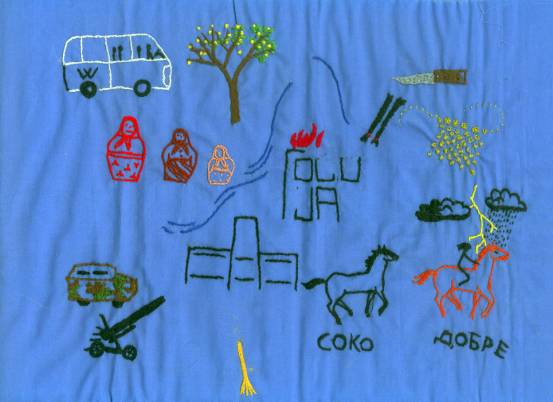
The only document of our first journey to Primišlje remained recorded
in the embroidery I worked on during the trip, from the series
Embroidered Diaries — Summer 2007
It took time, and many long telephone conversations, before we finally
found a way to reverse this disheartening situation. In the end, we
agreed that there was only one thing to do: return to Primišlje and
record everything all over again — only better this time.
We were prepared and had gained a new perspective, having now experienced
the fragility of memory and the dangers and traps of its irretrievable
loss. We would go back and film everything all over again. We adopted as
our motto: “Now that everything is lost, there is everything to gain!”
I immediately called Mother and Nana to tell them about the plan. They
were both delighted by the idea, and the whole incident with the lost tapes
even turned out to be an auspicious coincidence, giving us an opportunity
to revisit Primišlje.
This time, however, we managed to secure financial support to make the
film, unlike the first journey, which we had financed entirely ourselves.
Before long, we were once again on the road to Primišlje: the same team —
Mother, Nana, Dionis and myself — the same grey-blue van, and Dionis’s new
camera.
Unlike the first time, when everything had been completely new and required
us to react instantly, capturing unique moments as they happened, we could
now plan the filming more calmly and with greater ease. We already had some
idea of what we were looking for and what we might expect to find.
We visited the people in Primišlje whom we had met the year before and who
now greeted us as old acquaintances. We filmed landscapes, crumbling houses,
and my Nana telling us stories from her childhood, once and then all over
again.
Only now, compared with the year before, she had expanded her repertoire
even further. It seemed that the first visit had refreshed her memory, and
she had had an entire year to reminisce and make connections. Once she
started spinning her tales, there was no one who could stop her.
We followed her along paths overgrown with thorns and knee-high grass,
across the karst and lush groves, over rivers, and into half-demolished
houses. Sometimes, when Nana told us stories about things that had happened
half a century earlier on this or that very spot, people passing by would
stop and stay to listen — and listen carefully.
She told us stories as they came back to her, associating them with the
places through which we happened to be passing. And every time Nana told
us a story, she told it differently: adding more details, trying to make
it more convincing, leaving something out, emphasizing a different aspect.
She made an effort to connect things and bring them to a conclusion, to
give them meaning, to distil a moral.
One day we went to the cadastre office in Slunj to identify our property,
which was still registered in the names of my Nana’s parents. They had died
before I was even born, and probate proceedings had never taken place.
Now Nana, motivated by my interest and as the eldest in the family, took it
upon herself to resolve the inheritance.
I started fantasizing about building a house, a cottage, on a plot of land
next to the forest and a spring, on the banks of the Mrežnica River —
about “going back”, perhaps one day.
But that is a long-term project. For the time being, the house I am
“going back” to will be the one made of all my Nana’s stories.