My first return home was from Niš. I set out in mid-May, and returned to Belgrade for duty on 15 July 1946. Since there was no regular transport, I travelled very slowly. I came from Niš to Belgrade on official business, to look into the situation and see whether I could return to the Hygiene and Epidemiology Unit, where I could find work suited to my profession, rather than being demobilised somewhere or sent to some civilian hospital. Once I had been promised that they would take me back, I used my leave to go home to Kordun, which was a very risky thing to do.
When I got to about thirty kilometres from my home, there was no transport from there on. You had to continue along the road somehow, or find a private ride, a horse-drawn cart. I got off at the station early in the morning. The station was near Ogulin and was called Kukača. It was more like a stopping place than a station, with no traffic at all. Only people travelling and turning off along that road towards Slunj would get off there. I got off, and there was no one anywhere. There was only the stationmaster, whom I asked how I could get to Primišlje, via Tržić. He said: “The best way is to go across Jelen Gora. It will shorten your journey by two or three kilometres.”
I was wearing my uniform; it was already warm. I only took off my cap with the red star. I had my uniform because I had no other clothes. I also had a military pass, so that if anything happened to me along the way, I could ask for assistance, an escort or transport, or stop a military truck — I had the right to do that. But I couldn’t make use of any of it because I didn’t meet anyone.
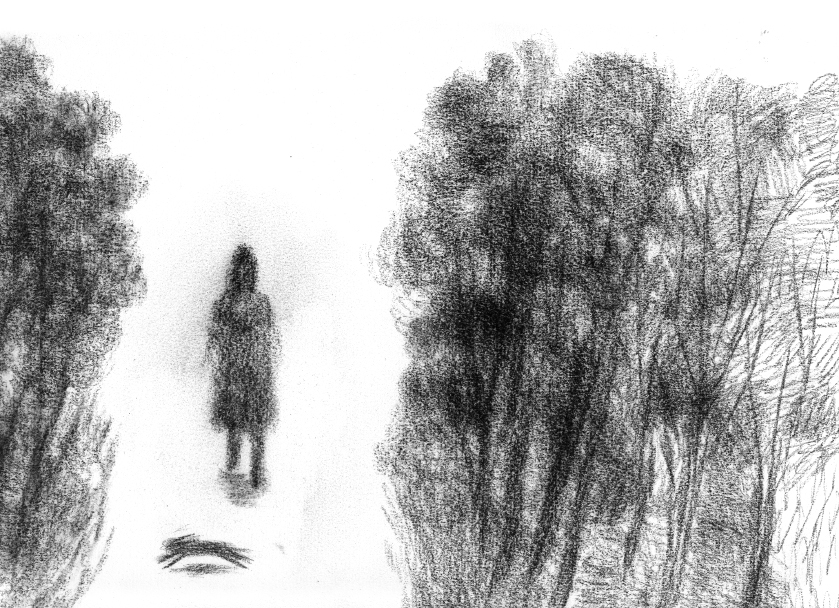
I set off through the forest. The vegetation had been badly damaged by the war, but it was still tall enough that I couldn’t see anyone anywhere, only the occasional rabbit darting across my path. And little by little, I began to feel uneasy and afraid.
I walked for a long time, an hour or two, some five or six kilometres through the forest, until I came out at a familiar place where, six years earlier, I had been with my father when he accompanied me on my way to Belgrade. The tavern there was open again, and inside I found the same woman who had been there when I left. Her name was Manda. She was a Croat, a woman who spoke in a different dialect and looked different from my people. The place was called Kamenica.
I asked her: “Aunt Manda, how am I going to get home?” — “Whose girl are you?” I told her whose I was and said that I had been there with my father, Đuro Gvozdić. I had been there before, and now I had stopped by again. She said: “Go quickly, while there is still daylight. It is very dangerous here. Take off that cap, and take off that military coat too. Go as quickly as you can, and don’t take any shortcuts. Stay on the road.”
I still had another eight kilometres to go. I crossed the Mrežnica, over that ruined bridge — somehow I managed to get across. I stayed on the road and didn’t take any shortcuts. The journey seemed to last forever. When I reached a place I knew, near Lazino Brdo, I left the road and went across fields, through valleys and woods, across water and streams, but I shortened the journey considerably. I reached home not by the road people normally used, but from behind the house, from a direction no one would expect anyone to come.
When I reached the house, my youngest brother saw me. He had been born after I left in 1940, and he said: “Here comes a lady.”
Then everyone gathered around, and the neighbours began to arrive. My family couldn’t believe it. They touched me to see whether it was really me, whether I was alive or some kind of doll. The greatest shock was for my father when he learned that I had come through Kukača and through Kamenica, an Ustaša place, instead of coming through Slunj and Veljun, where there was some kind of transport and military trucks carried people. But I didn’t know about that route, and I hadn’t really asked around much either.
Then he asked me: “But how did you cross the bridge near Tržić?” I said: “Quite easily. I held on to the broken railing and crossed.” — “Just yesterday, a masked group of three took my new boots from me there. I came home barefoot. How come they didn’t take your head off?” And I said: “My head is not for taking off.”
Then they calmed down a little and started asking: “But how did we get word that you had lost a leg?” Well, someone had heard: “She was wounded!” — “Where was she wounded?” — “In the leg!” And someone else added: “She has no leg!” So they concluded that I would come home disabled. They said: “Better that she isn’t alive, if she has no leg at nineteen or twenty years old.”
And so I went on being alive, and having my leg. Which means I had fooled them a little once again.