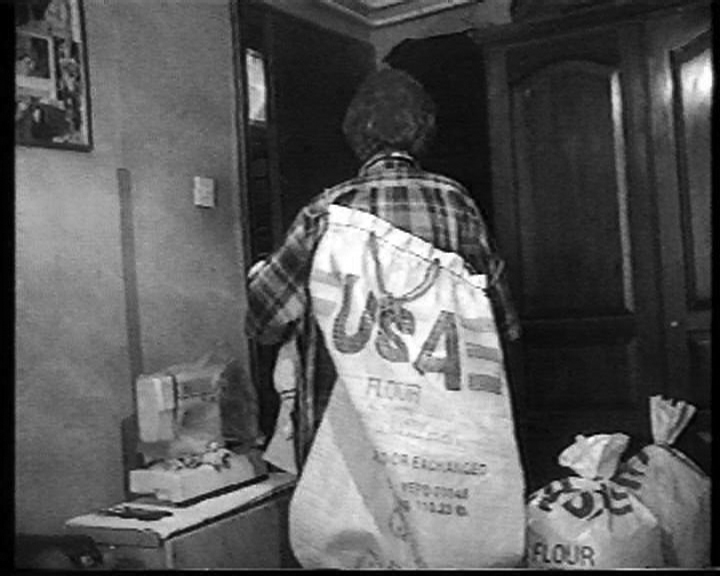
In December 2001, during one of my visits to Belgrade, Nana showed me a bag she had made earlier by modifying a humanitarian aid sack sent to Serbia after the bombing. Her idea was that the modification of this sack would mark the completion of the humanitarian mission for which the original aid had been delivered, while advocating the return home of the many people displaced from war-torn territories. (This probably included me as well, since at the time I was living in Spain.)
Soon afterwards, my mother, Nana and their neighbour Rade organised themselves and made a video in which Nana demonstrates how the bag is made and used.
Belgrade, 29 January 2002
For more than a decade I have been preoccupied with a problem which at times seemed insignificant to me amid the multitude of great problems that had afflicted my people, as well as many other peoples around the world.
It began with my first impressions of seeing on television masses of people, mostly women with children, leaving their homes in a state of chaos or preparing to leave them under the pressure of unimaginable terror. It is difficult for me to recall those times, or to remind others of them, although, to the misfortune of so many people, this situation still persists and seems to have no end in sight.
Even today, after so much time and reflection, I do not know how to define the problem properly. In fact, my attention was drawn more to the question of what people would pack their essential belongings into than to what they would choose to pack in such haste and chaos. Another priority for me was how they would carry those things and how they could move more easily under the burden.
The more I thought about the problem, the larger and almost insoluble it became. There was always the dilemma of how to devise a standard piece of luggage that would have to meet certain basic conditions: the material should be easy to obtain and available in sufficient quantities; only second-hand materials should be considered, requiring no financial expenditure; the material should be resistant to moisture, waterproof, lightweight, resistant to wear, flexible, and so on.
Another important consideration was the making of the bag itself: how, quickly and easily, with little effort and skill, to produce a standard piece of luggage — a bag adapted for use in an emergency. It was also intended that all these operations should be carried out through personal engagement, within the framework of self-help. This would give the whole undertaking additional significance.
And yet it seemed almost impossible to fulfil all these conditions. Time passed and the idea gradually began to leave me. I did not have the courage to tell anyone about it, thinking that it was unrealistic and belonged in the realm of fantasy and unrealised wishes, although at its core the idea was profoundly human and humane: how to help people and encourage them, in extraordinary circumstances, to help themselves, even if only through “small things”.
Then, as often happens, in early October 2001 I accidentally found myself holding an empty sack that had previously contained flour from humanitarian aid supplies. At first sight, the sack seemed to offer an ideal solution to my problem — it fulfilled almost all the conditions, and more. It had the appropriate quality and dimensions. Once its original humanitarian mission had been completed, it could have ended up as waste and remained an environmental problem for a long time. With a well-designed modification, however, it could become a new product that could continue to serve a humanitarian purpose.
The sack has a capacity of approximately 50 kilograms and standard dimensions — an appropriate width and length. This makes two simple solutions possible: folded in half, it becomes a hand-carried bag, while at its full size it can be used as a knapsack.